Singing Stone A Natural History of the Escalante Canyons

Ron NiebruggePhotos, Travel, Utah Leave a Comment

Throwing in a photo of the Escalante region of Utah doesn’t seem to fit with my recent Antarctica theme, but I can explain.

I first passed through the Escalante area more than 12 years ago and loved the region.  I expected to be blown away by the Moab area, Zion and Bryce, places you hear so much about, but Escalante came as a surprise.  It was immediately evident that the photo opportunities were endless.  My intentions were to return for an extended visit to really explore the area.   Lack of cell and internet access has kept us from making an extended visit – the disadvantage to being self employed, although I did spend a brief bit of time photographing the area in 2005, and more recently passed by to visit photographer friend Guy Tal, which reminded me again  how I loved the area.

Fast forward to Antarctica.  I found all the fellow staff members to be extremely knowledgeable, fascinating, and insightful.  One of the staff members was Thomas Lowe Fleischner (Tom), who is a professor of natural history at Prescott College in Arizona.  On the first day of our trip, Tom and I were paired together as part of a group hike into Tierra del Fuego National Park.  On that hike I really enjoyed Tom’s insight, and his ability to explain things in such an interesting way.  From then on I made a point of staying within earshot of Tom when I could, so that I might learn as much as possible.

Tom is also an author and it turns out that one of Tom’s books, Singing Stone, was about the natural history of the Escalante Canyon region (Capitol Reef National Park, Grand Staircase-Escalante National Monument and Glen Canyon NRA).  I love natural history books, and have many shelves of them.  But, most are guide book in style, with page after page of animal tracks, wildflowers or birds.  Tom was kind enough to share his book with me which I recently finished.

What I loved about Tom’s book is the story telling nature that covers all those things you wonder about when visiting the area.  I felt like I was hiking around the area with Tom as he explained things I asked about!  Not just birds and geology, but the history, the plant life, effects of management decisions and more.   It was fascinating – I wish there were similar books on other regions!

So what causes the dark streaks you see on the canyon walls?  Which adult hummingbird builds the nest and raises the young?  You will just have to read the book!


Ushuaia, Argentina

Ron NiebruggeArgentina, Photos, Travel 6 Comments

Ushuaia, Argentina.

Friends who had been to Ushuaia had told me it reminded them of my hometown of Seward, Alaska.  Sure enough, it did for me too.  A wet, snowy tourist town on the ocean, surrounded by mountains and National Park lands.   As the plane flew into the town’s airport, I was surprised at how even the geology seemed very similar – a far change from Buenos Aires, a town we had just flown out of 3 hours earlier.   At some 70,000 or more people, Ushuaia is far larger then Seward, but I did find myself feeling somewhat at home there despite the language and cultural differences.

Ushuaia is often billed as the Southernmost town in the world, although there is a small community nearby in Chile that disputes that claim for good reason – since they are further South.  One of the things that did surprise me, despite being about as far South as you can get in this World – further South then any place in South Africa, New Zealand or Australia, they really aren’t that far South.  Seward Alaska for example is far further North of the equator then Ushuaia is South.  Ushuaia’s latitude places it a little South of the Southernmost city in Alaska, Ketchikan.  So we didn’t have the crazy long days of sunlight like we do in the summer in Alaska, or like we would soon find in Antarctica.

Ushuaia is the typical starting point of most boat tours to Antarctica including ours.  There is a steady supply of interesting tour vessels into town – again, much like Seward, although many are icebreakers nothing like we typically see here.

Base W, Detaille Island

Ron NiebruggeAntarctica, Photos, Travel 6 Comments

Few Antarctica trips have the time to attempt so head South of the Antarctic Circle.  Of those, ice keeps many from making it.  Of the few that are able to reach this remote portion of Antarctica, most don’t have the permission to visit this amazing historical site that is been pretty much left undisturbed for over 50 years!   We were very fortunate to make it this far South, and that our EL Hugh Rose was able to work out permission to visit!  It was fascinating seeing just how people lived down here so many years ago.  Here is the interesting story on this location taken from the sign on the side of the building:

This relatively unaltered British scientific base from the late 1950’s provides an important reminder of the science and living conditions in the Antarctic during this period.

It was established in 1956 by the Falkland Islands Dependencies Survey (FIDS) as Base W and closed in 1959.  The base was primarily built for ongoing survey, geology and meteorology work, and contributed to the science programme of the International Geophysical Year (IGY) in 1957.  The normal occupancy of the base was 8 to 10 people.

The location of the island contributed to the base’s short history, as the sea ice was seldom firm enough to allow travel to the peninsula.  Ironically, when the time came to relieve the base in 1959, difficult ice conditions meant that the ship was unable to reach the island.  The base was secured for winter and the FIDS team were forced to sledge over 30 miles over the sea ice in order to reach the ship, taking with them only the minimum of their belongings and scientific records.  Apart from being briefly occupied for 6 month in 1965/66 by a visiting party of three from Stonington Island, who became stranded when the sea ice went out, the base has remained unoccupied since 1959, and much of the original contents are in place.

The site remains in relatively good condition and consists of the main hut, emergency store, dog pens, anemometer tower and two steel radio masts.  Many original materials can be found inside the main hut and scattered around externally, providing an evocative insight into the way the base was occupied during this period.

Whale Bones

Ron NiebruggeAntarctica, Photos, Travel 3 Comments

Whale bones on Jougla point on Wiencke Island, Antarctica.

I understand that this whale didn’t just die here, but this is from a collection of whale bones from around Antarctica and include humpback and blue whale bones.

Bells Alaska Travel Guides 2013

Ron NiebruggeAlaska, Shameless Self Promotion, Travel 6 Comments

I am very proud to have the cover of all three Bell’s Travel Guides in 2013!  We have been working with this wonderful family owned business for many years now.  You will find these guide books all over Alaska in gas stations, campgrounds, hotels and restaurants.  Be sure to pick them up if you see one – they are loaded with all kinds of information and have the best town maps!

Here are the other two:  Read More

August Bear Tour – 1 spot now open due to cancellation

Ron NiebruggeAlaska, Lake Clark, Photos, Travel 2 Comments

An unexpected career change has just lead to a sudden opening into my most popular photo tour – this trip was sold out by last October!  I already have a list forming of people interested in 2014!

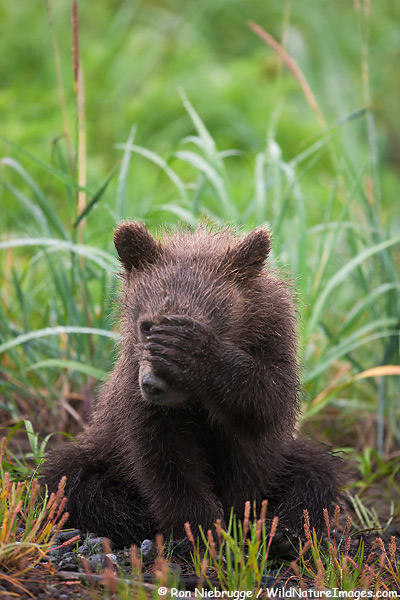
Plus, thanks to an airfare war – I’m seeing some of the cheapest airfares to and from the Lower 48 then I have seen in years!  So if you don’t already have summer plans, this just might be the perfect time to come to Alaska and experience these amazing animals up-close!  To learn more go to:  Alaska Bear Photo Tour.

Adelie Dive

Ron NiebruggeAntarctica, Photos, Travel 3 Comments

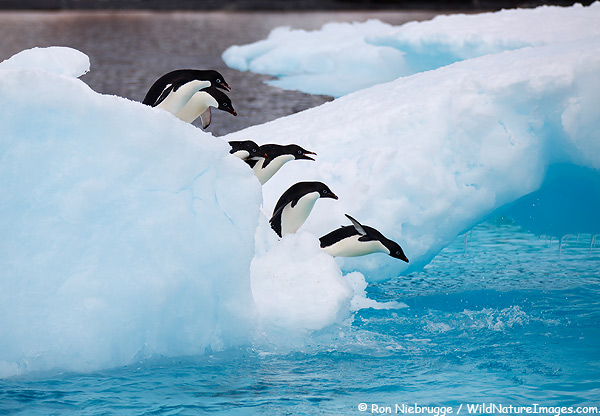
Adelie Penguin, Brown Bluff, Antarctica.

It was always fun to watch penguins enter the water.  Typically, none of them wanted to be the first to jump in – presumably out of fear of being eaten by a lurking Leopard Seal hiding out under the iceberg.  Once one went safely, they would all go.  Although the first one to jump usually wasn’t extra brave, but typically pushed in by the gathering mob behind it.