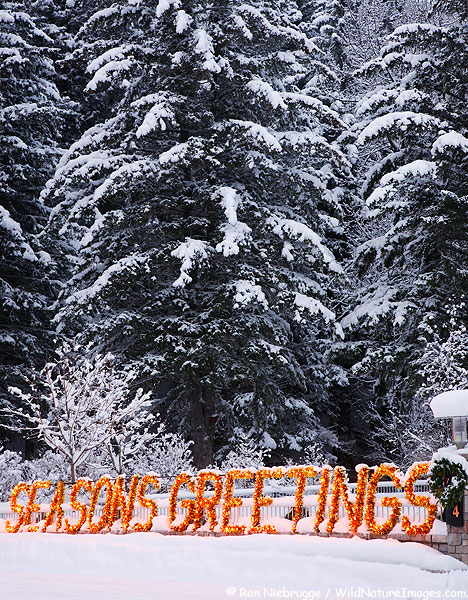
From a recent morning in Seward, Alaska.
Merry Christmas, Happy Holidays and Seasons Greetings everyone!
The next week will probably be a bit slow here on the blog thanks to the holidays.
Below you'll find a list of all posts that have been categorized as “Alaska”

Least Sandpiper, Seward, Alaska.
Megan from Costa Rica had an ask Ron question about bokeh. Here it is:
Hi Ron, I had a quick question for your Ask Ron series. I was wondering about your opinion of bokeh. I have a basic understanding of the concept from online research, but it seems that some professional photographers absolutely love it, while others barely use it at all. Also seems that subject matter doesn’t necessarily determine who likes it or not; in other words, I see some landscape artists use it all the time, and others never. I’m contemplating buying my first fixed focal lens for my Nikon D60, and am curious what your take is, when and how you decide to “go for bokeh” (ha), etc.
Thanks!
Megan in Costa Rica
For those that aren’t familiar with the term, here is the Wikipedia definition for bokeh: In photography, bokeh is the blur, or the aesthetic quality of the blur, in out-of-focus areas of an image, or “the way the lens renders out-of-focus points of light.
For me, I often use it for wildlife portraits, and close-up work like flowers – it allows me to isolate the subject from the rest of the scene and effectively “remove” distracting elements. I think the bird portrait above is a good example. Here I am actually laying in the cold water with the front of the lens and camera just barely out of the water in order to throw the background out of focus. If I was just a foot higher off the ground, I could be warm and dry, but the background of mud would come into focus and could be a distraction.
The background is often ignored, but can often make or break an image. As I’m setting up on birds like this, I’m not just watching the birds movement and the direction of the light, but I am constantly evaluating the background. A bright spot, even if it is out of focus will draw your eye right away from the subject and to the background bright spot.
Now I don’t always try to throw the background out of focus, there are times that it can enhance an image, and provide the viewer with a feeling for the habitat and surrounding environment. This photo of a desert bighorn near Moab, Utah is one example that comes to mind.
Now you mention landscape photography, and myself, I chose to maximize depth of field and keep everything in focus. I know some photographers utilize limited depth of field as a personal style, it seems to have gained in popularity in recent years. I encourage you to experiment. A prime lens with a large aperture can be a lot of fun creatively.
Thanks for the question – you live in a beautiful country!

Pedersen Glacier, Kenai Fjords National Park, Alaska.
It has been awhile since I have answered any Ask Ron questions. As a reminder, I will answer any photography question as best I can.
A couple of weeks ago I received this question:
I love how you capture a foreground, middle ground background with such great depth.
Do you typically try to accomplish this with a 24 T/S or the 24 1.4L?
Thanks, Ray
To answer your question, yes I do use Canon’s tilt shift lenses a fair amount. By tilting the plane of focus I am better able to position the depth of field from near to far without sacrificing a lot of shutter speed. I go into more detail in this post on tilt with Canon’s tilt shift lenses. These lenses are especially valuable when you have something really close, say within a couple of feet, and still want to keep distant objects in focus.
But, I don’t use those lenses as much as I should. It is so much easier, faster and lighter to carry one 24-105 then three tilt shift lenses. In these circumstances, I use a small aperture to maximize depth of field – usually around f/16. I then focus about 1/4 to 1/3 of the way into the scene. I also almost always will use a tripod, mirror lock up and the 2 second self timer to minimize any movement as much as possible. This is about as good as it gets without tilt. If something still has to be a bit out of focus I would rather it be distant objects – I believe prominent foreground elements have to be sharp – distant objects like mountains can be more forgiving.
Tomorrow I will answer another recent question on depth of field – this one regarding bokeh.
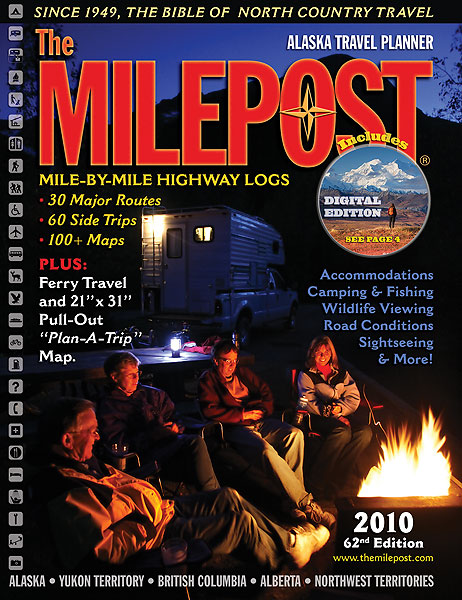
Cover, 2010 Milepost.
O man, I’m really excited to report that I have the cover of the Milepost for the 4th year in a row! Growing up in Glennallen everyone who passed through our restaurant had a copy in hand or on their dash. I dreamed of having the cover one day, I never imaged having 4 in a row! Now I dread the day I don’t have the cover – I’m going to have to work extra hard next summer!
Now that I travel so much I know why The Milepost is such a valuable resource. It has mile by mile detail on every road and community throughout Alaska, and on every route and community between Alaska and the Lower 48. My copy never leaves my truck. I have been recommending this guide for years on photography forums and on travel forums like RV.net
The main photo is actually of Janine and I with my parents, as we enjoyed an evening campfire at the Chugach National Forest Williwaw Campground near Portage. By the way, Williwaw is one of the nicest campground in Alaska. I used a self timer to trigger the camera. The smaller photo is of Janine in front of Denali (Mt. McKinley).
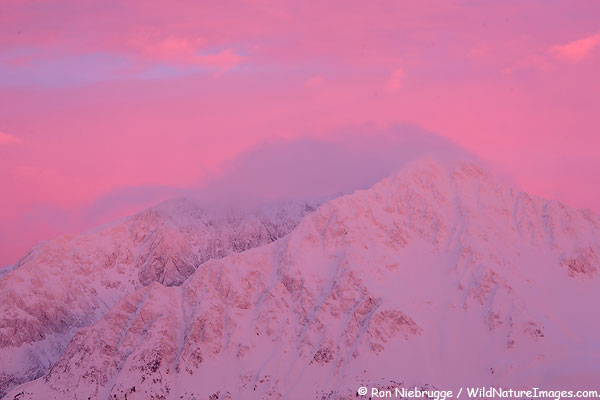
Alpenglow on Resurrection Peaks, Chugach National Forest, near Seward, Alaska.
This is looking North, directly away from one of the most amazing sunrises I have ever seen in Seward – the same morning of my recent post on sunrise over Resurrection Bay. This has to be the most dramatic, colorful alpenglow I have ever seen.
I must confess, I have often mis-used the word alpenglow. Thanks to blog reader Aaron for setting me straight on my welcome home post. As Aaron pointed out, and further research confirmed, alpengow is the pink glow you see while the sun is still below the horizon. There can not be a direct path of light from the sun to the mountain. So that red / orange light shinning on snow caped peaks at the beginning or end of the day isn’t really alpenglow – I have been mis-identifying it for years. I don’t know what it is called – sweet mountain light I guess.
This is pretty much straight out of the camera. I added a little contrast to the mid-tones, but I didn’t add any color or saturation.
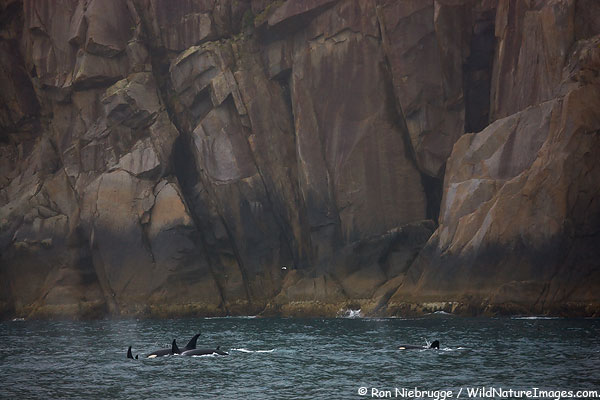
Orcas work their way along the outer coast, Kenai Fjords National Park, Alaska.
I captured this photo just before our fall trip – we are now converting and processing images from the end of summer, and from our Fall trip. I hope to share more here over the next few weeks as we do.
I thought the orcas were cool – but I really liked that rock wall behind them.
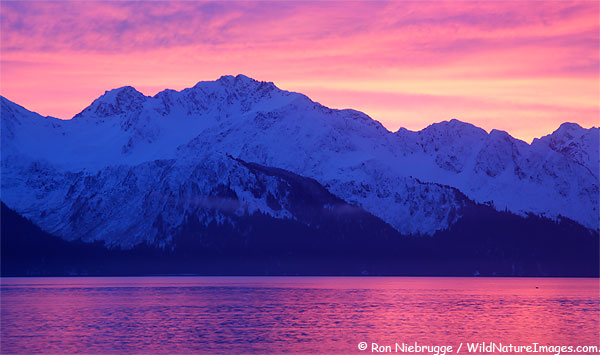
Sunrise over Resurrection Bay, Seward, Alaska.
Like my last post, this was also captured last Sunday morning. The clouds first started turning pink at 8:30 a.m. Yesterday’s post was captured at about 9:30. And, the first light of day wasn’t until after 10:00. We had hours of amazing light!
This is one of 5 photos that will eventually make up a panoramic.
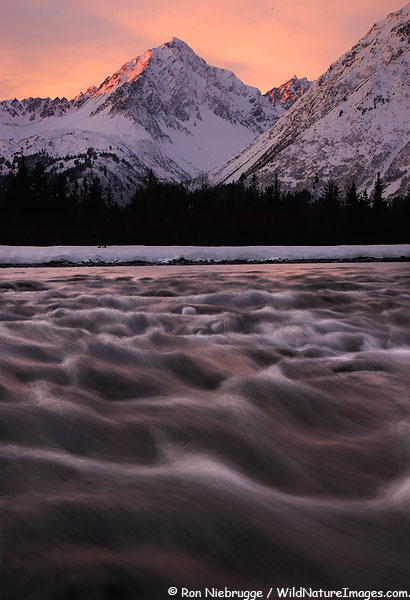
Resurrection River and Mt. Marathon, Seward, Alaska.
We have had an amazing stretch of weather combined with some wonderful winter light – I did a lot of photography this weekend! Here I waded out into the river and got as low as possible.
This is looking South toward Mt. Marathon and the bowl area, a place we spent the night last summer. You might remember this image from Mt. Marathon looking North from Mt. Marathon down towards the Resurrection River.


Recent Comments